
Email Management for GPs: Take the Practice Inbox Off Reception
Repeat prescriptions, appointment changes, hospital letters, medical card queries and insurance report requests all land in the same mailbox — while reception is already holding a queue on the phone. The AI Email Manager does the sorting and the first draft.
Email management for GPs is the daily work of keeping a practice inbox in order: repeat prescription requests, appointment changes, hospital and consultant correspondence, medical card and GMS admin. AgentHub's AI Email Manager sorts every message as it arrives, drafts replies to routine administrative categories for your staff to approve, and routes clinical post to the named GP. Administrative email only — it never triages symptoms and never gives medical advice.
See It Working on Your Practice Inbox
No contract, cancel anytime · Irish, PhD-led team · Live in days
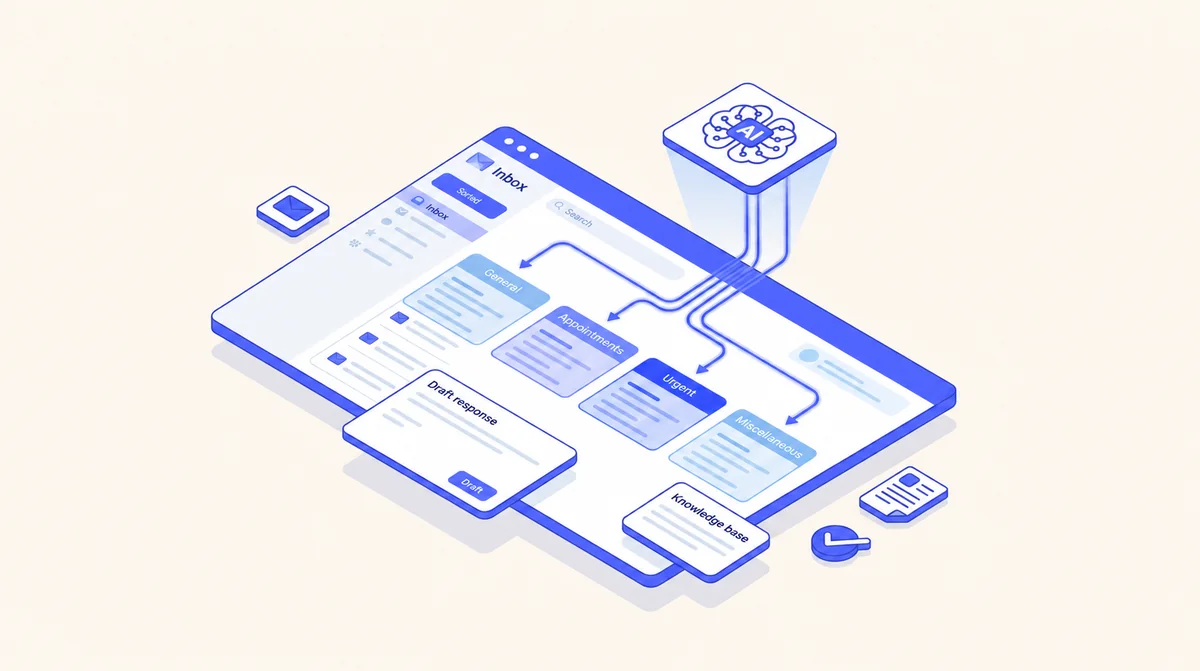
The Email Manager sorting a practice mailbox: prescriptions, appointments, admin and clinical correspondence separated before a staff member opens it.
Private AI for Irish GP Practices
Patient correspondence and practice records carry obligations that a public chatbot cannot satisfy, and staff pasting text into one is a risk you cannot audit. Local AI runs on a dedicated machine inside the practice, so administrative documents can be searched and summarised without leaving the building.
- 🏢 On-premise Local AI
- ☁ Cloud-based AI Receptionist
- ☁ Cloud-based Email Manager
- ☁ Cloud-based Leads Outreach
One Practice Mailbox, Six Completely Different Jobs
A GP practice inbox is not one queue. It is a repeat prescription request from a patient on a long-term medication, an appointment cancellation for tomorrow morning, a hospital discharge summary, an outpatient appointment letter for a consultant clinic, a medical card renewal query, a solicitor asking for a medical report, an insurance company chasing a form, and a circular about the flu vaccination or CervicalCheck programme. They arrive in one undifferentiated list, and they belong to five different people.
Meanwhile reception is on the phone. Anyone who has stood behind an Irish practice desk at ten past nine knows the shape of it: the phone queue is the emergency, so the inbox is what gets looked at later. Later means a prescription request read at half four, a consultant's letter sitting unopened for three days, and a patient who emailed precisely because they could not get through on the phone deciding to ring again tomorrow.
Our AI Email Manager does the first pass the moment each message lands, so nothing waits for a quiet ten minutes that never arrives. If you want the wider picture of how automation fits into Irish primary care, we wrote about it in AI automation for GP clinics in Ireland.
The Same Post, Handled Two Ways
The same messages arrive either way. The difference is what state the mailbox is in when a staff member finally opens it.
| What lands | Read whenever reception gets a gap | With the AI Email Manager |
|---|---|---|
| Repeat prescription request | Opened at half four, because the phone queue came first all day | Sorted into the prescription queue on arrival and put in front of the GP or practice nurse for the clinical decision |
| Appointment booking or cancellation | Sits in the same undifferentiated list as everything else until someone has a quiet ten minutes | Categorised on arrival, with a confirmation drafted in your wording for a staff member to approve |
| Hospital discharge summary or consultant letter | Can sit unopened for three days, waiting to be spotted by whoever looks at the inbox next | Routed straight to the GP named on the correspondence, never filed away unread |
| Medical card or GMS query | Needs a staff member to stop, work out which form or office applies, and write the reply from scratch | Filed to practice admin with a drafted reply already pointing the patient at the right form or office |
| Insurance form or solicitor's report request | Chased by the insurer before anyone gets to it | Flagged as a chargeable report, acknowledged with your standard fee and turnaround wording, queued for the named GP |
| Anything clinical or urgent | Silence, which the patient reads as "they have seen it" | Escalated to practice staff immediately and unanswered, with an auto-acknowledgement that states plainly email is not for emergencies |
Practice Inbox Management That Knows a Script Request From a Discharge Summary
Three jobs, done before a staff member opens the mailbox.
Sorted Into Practice Categories
Every message is filed on arrival: repeat prescriptions, appointments, practice admin, and clinical correspondence. Medical card and GMS queries, insurance and medical report requests, and screening programme mail each get their own lane instead of one shared pile.
Drafted Replies Staff Approve
Routine administrative categories come back with a reply already written in the practice's wording — appointment confirmations, forms attached, medical card renewal pointers. A staff member reads it and clicks send. Nothing goes to a patient unapproved unless you switch that on deliberately.
Clinical Post to the Named GP
Discharge summaries, consultant letters, radiology and laboratory correspondence are routed straight to the GP named on them, not left to be spotted by whoever opens the inbox next. Unread clinical post is the risk that keeps practice managers awake; this closes it.
Live in Days, Without Disrupting a Single Clinic
We Map Your Practice Inbox
A short call with your practice manager: what arrives, which GP handles which correspondence, how repeat prescriptions are processed, and exactly where your clinical boundary sits.
We Connect, You Approve
The AI connects to your existing Microsoft 365 or Google Workspace mailbox. Every category starts in draft-for-approval mode, so for the first weeks your staff simply see what it would have sent.
Reception Gets the Phone Back
Once you trust the drafts, you release the categories you choose — usually acknowledgements and internal admin first. Patient-facing replies stay on approval as long as you like.
The Line We Will Not Cross: Administrative Email Only
This is the first question every GP asks, so here is the plain answer before you have to ask it.
The AI Email Manager never triages symptoms, never assesses clinical urgency and never gives medical advice. It has no clinical role whatsoever. If a message looks clinical, describes symptoms, or reads as urgent, the AI stops, writes nothing, and escalates it to practice staff immediately. Clinical judgement stays where the Irish Medical Council expects it: with the doctor. The AI is there to stop administrative post burying the clinical post — that is the whole of its job.
| What lands in the practice inbox | What the AI does |
|---|---|
| Repeat prescription request for a stable long-term medication | Sorted into the prescription queue, matched to the patient, presented to the GP or practice nurse for the clinical decision — the AI never authorises anything |
| Appointment booking, change or cancellation | Categorised and a confirmation drafted in your wording for staff to approve |
| Medical card, GMS or HSE administrative query | Filed to practice admin with a drafted reply pointing the patient at the right form or office |
| Insurance form or solicitor's medical report request | Flagged as a chargeable report, acknowledged with your standard fee and turnaround wording, queued for the named GP |
| Hospital discharge summary or consultant letter | Routed straight to the GP named on the correspondence — never auto-answered, never filed away unread |
| "I've had chest pain since last night" | Escalated to practice staff immediately, unanswered. The AI does not assess it, reply to it, or decide how urgent it is |
| Screening or vaccination programme correspondence | Filed to the relevant programme lane so it reaches the staff member who runs recalls |
We also set your automatic acknowledgement so patients are told, in the first line and in plain language, that email is not for emergencies, that the mailbox is not monitored outside practice hours, and that anything urgent means ringing the practice, the out-of-hours co-op — Caredoc, ShannonDoc or D-Doc, depending on where you are — or 112 or 999. Patients often email because the phone was engaged; the acknowledgement has to catch that honestly rather than let silence imply the message has been seen.
Special-Category Data Stays in Your Mailbox
Health data carries the heaviest obligations under GDPR. We treat it that way.
Patient email is special-category personal data under Article 9 of the GDPR, and your practice remains the data controller. So the AI works inside your own Microsoft 365 or Google Workspace tenant, on EU infrastructure. Messages are not copied into a separate inbox we hold, they are not retained beyond processing, and nothing from your practice is used to train any model. We sign a data processing agreement, document the processing so it drops straight into your record of processing activities, and keep the arrangement one your Data Protection Officer can defend to the Irish Data Protection Commission without a long explanation.
Secure clinical channels are a separate matter. If your practice sends and receives clinical correspondence through Healthmail, you can leave that untouched — most practices point the Email Manager at the general practice mailbox only, which is where the administrative load actually sits. The same approach applies to any Irish business handling sensitive mail: see how it works generally on our email management and email management Ireland pages.
What Our Clients Say
Repeat prescription requests used to be read whenever reception got a gap. Now they are sorted and queued the moment they arrive, and consultant letters go straight to the right GP instead of waiting in a shared inbox.
What sold it to our partners was what it refuses to do. Anything remotely clinical is put in front of a person straight away. It only touches medical card queries, forms and appointment admin — and that is most of our inbox.
An Irish AI Company, Not a Reseller
Built in Ireland
We're an Irish company. Your setup, support and the person answering your questions are all here — see who we are.
PhD-Led Team
Founded by a Computer Science PhD with 27+ years in software, including 15 years at IBM Ireland.
Security First
Co-founded by a Security Architect. Patient email stays in your tenant, under GDPR, with a data processing agreement in place before we connect anything.
Live in Days
Most practices are connected and sorting within days, and every category starts on approval — you see the drafts long before you trust them.
Which AgentHub Agent Fits Which Problem
Most practices recognise themselves in one row. That row is the first project.
| The problem in your practice | The agent | What it does about it |
|---|---|---|
| The practice mailbox only gets looked at once the phone queue clears | Email Manager | Sorts prescriptions, appointments, admin and clinical post the moment each message lands, and drafts the routine replies |
| The phone rings out at ten past nine, at lunch, and after surgery closes | AI Receptionist | Answers every call, books and cancels appointments, and escalates anything clinical — the practice configuration is on the AI receptionist for GPs page |
| Enquiries to a private or specialist clinic going unanswered | Leads Outreach | Follows up new enquiries quickly and captures them in a consistent shape — see lead generation for GPs |
| Not sure which of the three to start with | AI solutions for GPs | Sets out the whole picture for a practice and where the first project usually pays back fastest |
| The same shared-inbox problem, outside primary care | Email management | The general version of this service, with the Irish context on our email management Ireland page |
Email Management for GP Practices: Your Questions Answered
Does the AI triage patient symptoms or give medical advice?
No. Never. The Email Manager handles administrative email only. It does not assess symptoms, does not answer clinical questions and does not offer advice of any kind. Anything that reads as clinical or urgent is escalated to practice staff immediately, unanswered.
What kinds of email can it actually handle for a GP practice?
Repeat prescription requests, appointment bookings and cancellations, medical card and GMS queries, insurance and medical report requests, screening and vaccination programme correspondence, supplier and HSE circulars, and the routing of hospital and consultant letters to the named GP.
Where is our patient data stored, and is it GDPR compliant?
Patient email is special-category data under GDPR, so it stays in your own mailbox. The AI reads and drafts inside your Microsoft 365 or Google Workspace tenant on EU infrastructure. Nothing is copied to a third-party inbox and nothing is used to train models. We sign a data processing agreement and support your Irish DPC obligations.
Will it email patients without a member of staff seeing it first?
Not unless you decide it should. Every category starts in draft-for-approval mode: the AI writes, a staff member reads and clicks send. Most practices keep patient-facing categories on approval permanently and only automate internal admin and acknowledgements — the mechanics are covered on our automated email response page.
What happens if a patient emails something urgent?
It is flagged to practice staff straight away and never handled automatically. We also set your auto-acknowledgement to state plainly that email is not for emergencies, that it is not monitored out of hours, and that patients should ring the practice, the out-of-hours co-op such as Caredoc, ShannonDoc or D-Doc, or 112 or 999.
Does it work with the email system our practice already uses?
Yes. It connects to the general practice mailbox you already run on Microsoft 365, Outlook or Google Workspace. No migration and no new address. Secure clinical channels such as Healthmail can be left entirely untouched if you prefer.
Let Reception Answer the Phone Again
Tell us what a normal week looks like in your practice mailbox and we'll show the Email Manager sorting it.
Prefer to talk? Email sghaith@agenthub.ie or call 087 788 2676.