
AI Solutions for GPs: Administrative Only, Never Clinical
We automate the paperwork and the phones in Irish general practice — repeat prescription requests, bookings, medical-card admin, hospital letters. We do not triage, diagnose, or give medical advice. Ever.
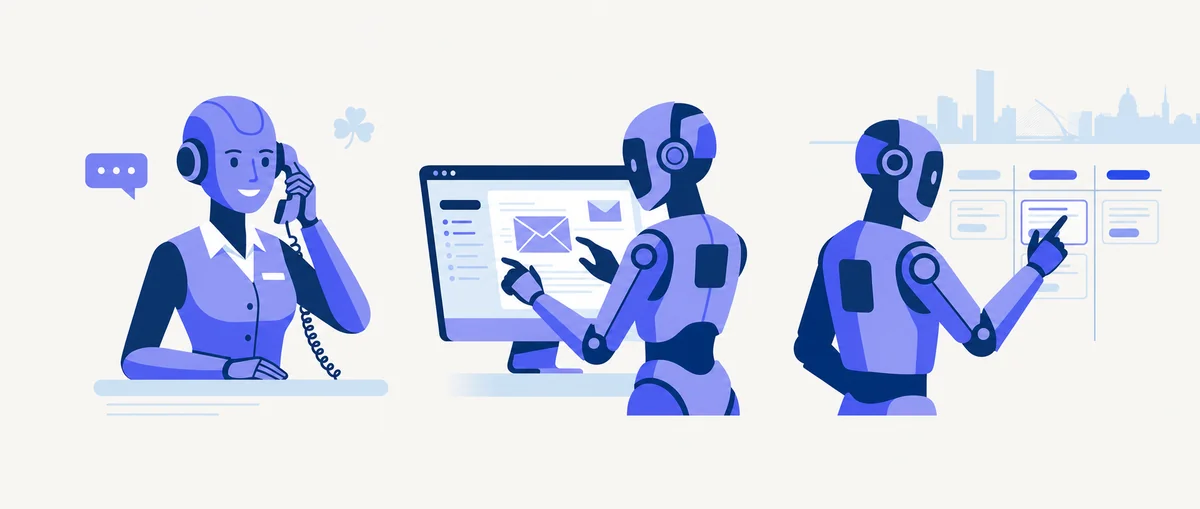
AI solutions for GPs, done responsibly, are administrative: answering the 9am phone crush, logging repeat prescription requests, managing bookings and no-shows, handling medical-card and GMS paperwork, and routing hospital correspondence. AgentHub builds that layer for Irish practices — and draws a hard line at anything clinical, which stays with your GPs and nurses.
Book a Practice Admin Review
No contract, cancel anytime · Irish, PhD-led team · Live in days
Want to see one working before you talk to us? Open the chat bubble in the corner of this page — that agent is one of ours, answering questions about our own business exactly the way a practice agent would answer admin questions about yours.
Private AI for Irish GP Practices
Patient correspondence and practice records carry obligations that a public chatbot cannot satisfy, and staff pasting text into one is a risk you cannot audit. Local AI runs on a dedicated machine inside the practice, so administrative documents can be searched and summarised without leaving the building.
- 🏢 On-premise Local AI
- ☁ Cloud-based AI Receptionist
- ☁ Cloud-based Email Manager
- ☁ Cloud-based Leads Outreach
Administrative Automation. No Triage, No Diagnosis, No Advice.
Start here, because it's the first question every practice manager asks and most AI vendors answer it vaguely. We build administrative automation only. Our agents do not assess symptoms, do not suggest what might be wrong, do not recommend a course of action, and do not answer clinical questions — not even the ones that look harmless, like whether a rash can wait until Thursday. Software that interprets symptoms to inform diagnosis or treatment is a regulated medical device under the EU Medical Devices Regulation, and that is not what we sell.
In practice this means every agent ships with a hard escalation rule: any contact that mentions symptoms, pain, medication effects, pregnancy, mental health or anything time-critical is handed to your staff immediately — during surgery hours to reception or the duty GP, outside them to your out-of-hours co-op, whether that's Caredoc, ShannonDoc, D-Doc or another. The agent says plainly that it's an administrative assistant and cannot help with medical matters. Clinical judgement stays with your clinicians, and so does the responsibility the Irish Medical Council places on them.
Where the Line Sits, Request by Request
| What comes in | What the agent does | What it never does |
|---|---|---|
| Appointment booking, changes and cancellations | Books, moves and confirms; offers freed slots to patients on the list | Decide how urgently a patient needs to be seen |
| Repeat prescription requests | Captures patient, medication and pharmacy into one structured list for GP review and signature | Approve, alter or issue any prescription |
| Medical-card and GMS admin | Explains what's needed, collects the details, flags the file for your administrator | Decide or confirm eligibility on the HSE's behalf |
| Insurance, driving-licence and pre-employment medicals | Logs the request with form type, consent status and fee, and queues it for the right GP | Complete, sign or interpret any medical report |
| Hospital and consultant correspondence | Reads, classifies and routes each letter to the named GP, flagging anything urgent for immediate human review | Act on the contents of a letter or touch the clinical record |
| Symptoms, pain, medication effects, mental health | Says plainly that it is an administrative assistant, then hands the contact to reception or the duty GP immediately | Assess symptoms, suggest a cause, or advise what to do next |
| Contact outside surgery hours | Directs the caller to your out-of-hours co-op — Caredoc, ShannonDoc, D-Doc or another — or to 112, and logs routine requests for the morning | Attempt to handle a medical problem itself |
Where AI Earns Its Keep in a General Practice
Three places the admin load is heaviest — and where automation is safest.
The 9am Phone Crush
Between 8:30 and 10:00 a practice can take a week's worth of calls in ninety minutes. An AI receptionist for GP practices answers every line at once, books and moves appointments, and passes anything clinical straight to reception.
Repeat Prescriptions and Forms
Requests arrive by phone, email and at the hatch. The agent captures patient, medication and pharmacy into one structured list for the GP to review and sign — it never approves, alters or issues anything itself.
The Practice Inbox
Hospital discharge letters, consultant replies, insurance forms and patient queries land in one address. Email management for GP practices sorts and routes each to the right GP or administrator with a draft reply ready.
One Bottleneck First, Live in Weeks
Pick the Worst Hour
We sit with your practice manager and find the single heaviest admin load — usually the morning phones or the repeat prescription pile. We automate that, not the whole practice.
Built Around Your Protocols
Your appointment types, your escalation rules, your co-op, your wording. The agent works alongside Socrates, Helix or whatever system you run — it doesn't replace it and never writes to the clinical record.
Staff Approve, Then Hand Over
It runs in parallel for the first weeks while your team checks everything it produces. You widen its remit only when your staff trust it. Most practices are live within weeks.
The Administrative Burden an Irish GP Practice Actually Carries
None of this is clinical work. All of it lands on the same three or four people at the front desk.
| Practice task | How it goes today | What the agent does |
|---|---|---|
| Morning call surge | Three lines ringing, patients redialling, reception triaging queues rather than people | Answers every caller at once, books or moves the appointment, escalates anything symptom-related |
| Repeat prescription requests | Phone messages, emails and notes at the hatch, collated by hand for the GP | Captures patient, medication and pharmacy into one structured list for GP review and signature |
| Bookings, changes and no-shows | Manual rebooking; empty slots that could have gone to someone on the list | Confirms and reminds by SMS, offers freed slots to waiting patients, logs cancellations |
| Medical cards and GMS admin | Eligibility queries, renewals and change-of-address chased between patient and HSE | Explains what's needed, collects the details, flags the file for your administrator to submit |
| Insurance, driving-licence and pre-employment medicals | Requests scattered across post, email and phone; fees and consent chased separately | Logs each request with the form type, consent status and fee, and queues it for the right GP |
| Hospital and consultant correspondence | Letters read and re-sorted by whoever opens the post | Reads, classifies and routes each letter to the named GP, flagging anything marked urgent for immediate human review |
| Recall and vaccination programmes | Flu, childhood immunisations and chronic-disease reviews chased in spare moments that don't exist | Runs the reminder list and books the returns — the same outreach agent logic, pointed at patient recall instead of sales |
| Out-of-hours contact | Answering machine message, or calls simply lost | States it cannot help medically, directs to your co-op or 112, logs routine requests for the morning |
Read across that table and the pattern is clear: almost none of it needs a clinician, but nearly all of it currently interrupts one. Our productised agents cover most of it directly — the AI receptionist for calls, the email manager for correspondence — and anything specific to how your practice runs gets built on the same foundations. For a longer look at what practices around the country are already automating, read our piece on AI automation in Irish GP clinics.
Special-Category Data, Handled Accordingly
Anything a patient tells your practice is health data — special-category data under Article 9 of the GDPR, with the Irish Data Protection Commission as your supervisory authority. We design for minimisation first: the agent captures only what the administrative task needs and nothing more. It does not read your clinical records, and it does not need to.
Processing runs on EU infrastructure with Irish data residency, under a written data processing agreement that names exactly what is processed, where it is stored and for how long. Your practice stays the data controller; we are the processor and act on your instructions. Staff remain in the loop by design — prescriptions, medical reports and anything requiring a clinician's signature are prepared for approval, never actioned automatically. AgentHub is co-founded by a Security Architect, and that shows up in the boring details: access control, retention limits and audit trails your DPC file can point at.
What Our Clients Say
Since installing AgentHub's AI receptionist, we haven't missed a single patient call. It handles appointment queries after hours and our front desk staff can focus on in-clinic care.
The repeat prescription requests used to arrive in four different places. Now they come to our GPs as one clean list to review and sign. Nothing clinical was ever handed to the software, which is exactly what we wanted.
A Small Irish Team, Senior Enough to Say No
Built in Ireland
An Irish company that understands GMS admin, medical cards and co-ops. Setup and support come from here — see who we are.
PhD-Led Team
Founded by a Computer Science PhD with 27+ years in software, including 15 years at IBM Ireland. You talk to the people who build it.
Security First
Co-founded by a Security Architect. Health data is handled as special-category data, on EU infrastructure, under a written processing agreement.
Clear on Scope
We turn down anything clinical. That limit is why practices trust the admin work to us — read our guide to choosing an AI company in Ireland.
Which AgentHub Agent Fits Which Practice Problem
| The problem | The agent | What it does for a practice |
|---|---|---|
| Phones ringing out during the morning crush | AI Receptionist | Answers every line at once, books and moves appointments, escalates anything clinical — detail on AI receptionists for GP practices |
| Hospital letters and patient email backing up | Email Manager | Sorts and routes correspondence to the right GP with a draft reply ready — detail on email management for GP practices |
| Recalls, flu clinics and chronic-disease reviews never chased | Leads Outreach | Runs the reminder list and books the returns — the same logic behind patient outreach for GP practices |
| Repeat prescriptions, medical-card admin and medical reports | A custom administrative agent | Built on the same foundations and configured to your protocols — how we work is set out in our guide to choosing an AI company in Ireland |
AI in General Practice: Your Questions Answered
Does the AI triage patients or give medical advice?
No. We build administrative automation only — no symptom triage, no diagnostic support, no clinical decision-making and no medical advice of any kind. Anything that touches diagnosis is a regulated medical device and is firmly out of scope for us. Urgent or symptom-related contacts are escalated to practice staff immediately.
What can AI actually do in an Irish GP practice?
The admin that fills the day: answering the 9am phone crush, taking repeat prescription requests, handling bookings, cancellations and no-show reminders, chasing medical-card and GMS paperwork, logging insurance and driving-licence medical requests, and routing hospital letters to the right GP.
How do you handle patient data under GDPR?
Health data is special-category data under Article 9, so we design for minimisation first: the agent captures only what the admin task needs. Processing runs on EU infrastructure with Irish data residency, under a written data processing agreement, and your practice remains the data controller answerable to the Irish DPC.
Do we have to change our practice management system?
No. The agent works alongside Socrates, Helix or whatever you run — it captures structured requests and hands them to your team in the format they already use. We start with one bottleneck rather than a whole-practice rollout, so nothing about your clinical records changes.
What happens to calls outside surgery hours?
The agent answers, states clearly that it cannot help with medical problems, and directs the caller to your out-of-hours co-op — Caredoc, ShannonDoc, D-Doc or whichever covers your area — or to 112 for emergencies. Routine requests are logged for the morning, so nothing is lost.
How long does it take to go live?
Weeks, not quarters. We start with the single worst bottleneck — usually the morning phones or repeat prescriptions — configure it around your protocols, run it alongside your staff while they approve its output, then hand over. There is no contract.
Give Your Front Desk Its Mornings Back
Tell us which hour hurts most and we'll show you an admin agent handling it — no contract, cancel anytime.
Prefer to talk? Email sghaith@agenthub.ie or call 087 788 2676.