
A Local LLM for Your Business, Without Running It Yourself
You can download an open-weight model tonight and have it answering questions on a laptop by midnight. Turning that into something a 20-person firm relies on every day is a different job. That job is what we sell.
A local LLM is a large language model — the software behind AI chatbots — running on your own hardware instead of a provider's cloud. AgentHub picks the open-weight model, sizes and supplies the machine, installs private chat and document search, connects your existing sign-in and handles model upgrades, so Irish businesses get a local LLM without a DIY project.
Book a Local LLM Consultation
Model, hardware and support quoted after one call · Irish, PhD-led team · No per-token fees
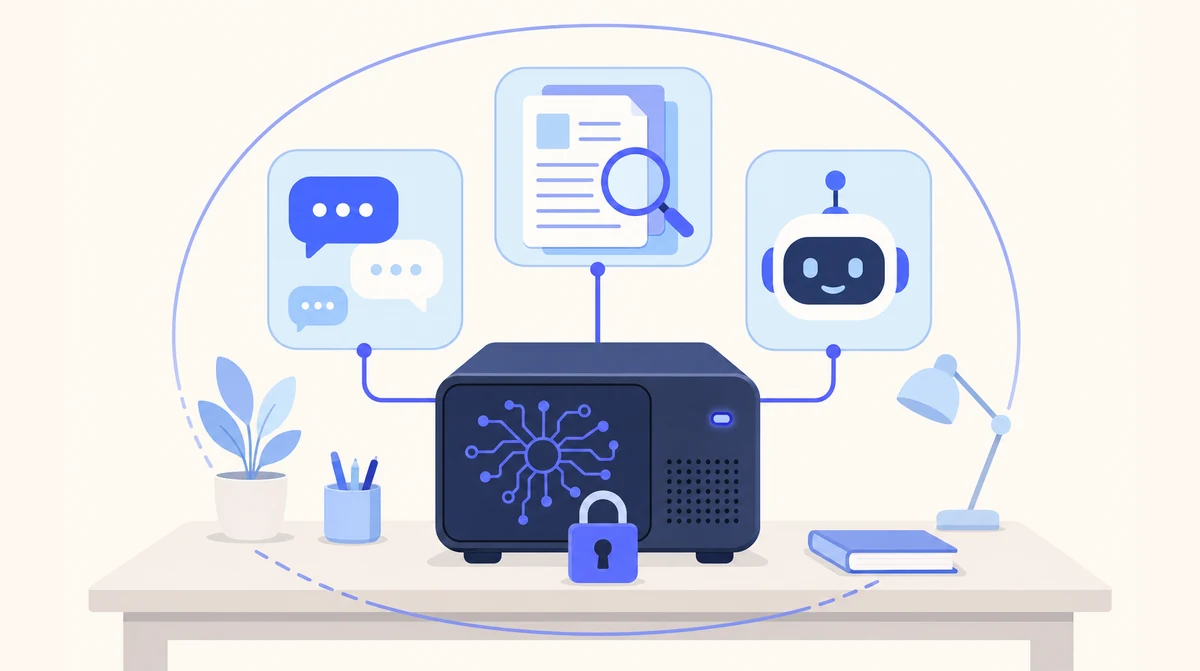
The model runs inside Local AI, our on-premise product — chat, document spaces and assistants on one machine we specify, install and keep upgraded.
What Is a Local LLM?
A local LLM is a large language model — the software that reads your question and writes the answer inside any AI chatbot — running on a computer you own rather than a provider's servers. It's possible because some model makers publish their models' weights, the trained model itself, so anyone can download and run them: open-weight models.
On its own, a downloaded model is a chat window on one machine. For a business you also need it serving several people at once, searching your documents with citations, respecting who is allowed to see what, backed up, and upgraded when a better model comes out — which, at the moment, is every few months. That layer around the model is what Local AI is.
Run an LLM Locally Yourself, or Have It Done: What's Actually Involved
We've done both. Here is where the time goes when you run LLM locally for a real team, against what we take on.
| The job | DIY local LLM | AgentHub Local AI | Cloud chatbot |
|---|---|---|---|
| Choosing the model | You, from hundreds of options that change monthly | We pick it for your jobs and hardware, and re-pick as models improve | The provider decides |
| Sizing the hardware | Guess the graphics card, buy, discover it's too small | Specified and supplied by us after a short call | None needed |
| Serving several users at once | Your problem — a laptop model serves one person | Built in; the machine is sized for the team | Built in |
| Searching your own documents | A second project on top of the first | Document spaces with page-level citations, included | One upload at a time, into the provider's storage |
| Sign-in and access control | Usually nothing — whoever finds the URL | Single sign-on with Microsoft 365 or Google Workspace | Provider accounts, often personal |
| Updates and model upgrades | Whenever someone remembers | Ours, on an agreed schedule | Automatic, on the provider's terms |
| Where your data goes | Stays local | Stays local — only sign-in touches the internet | The provider's servers |
| Support when it breaks | Forum threads at 11pm | The people who installed it | A ticket queue |
If you're technical and it's for you alone, the DIY column is a fine weekend. If it's for the accounts team and the matter files, the middle column is the one that still works in month six. Our AI server page covers the hardware side of that column in detail.
Which Is the Best Local LLM for a Business?
There is no single best local LLM — the answer changes every few months and depends on the job and the hardware. The right question is "best for summarising 60-page contracts on this machine", and that has an answer. We choose the model for your workload, test it on your documents, and swap it when a better one arrives.
Model upgrades are part of the support arrangement, so the pick stays current. We deliberately don't name models on this page. Any list of local LLM models is out of date within a quarter, and a page that recommended a specific one would be doing you a disservice by the time you read it. What doesn't change is how we choose:
| What we weigh | Why it matters for your business | What it changes |
|---|---|---|
| The jobs it will do | Summarising, drafting and extracting from documents need different strengths from open-ended reasoning | Which model family we shortlist |
| Document length | A 60-page lease or a full tender pack has to fit in what the model can read at once | The context size we need, and therefore the memory on the machine |
| Speed at your team size | Five people asking at once on a Monday morning must not queue | Model size versus the graphics card we specify |
| Licence | Some open-weight models restrict commercial use | Whether we can deploy it for you at all |
| Languages and accuracy on your files | Tested on your own documents before go-live, not on a benchmark | Final pick — and the baseline we measure upgrades against |
A Private LLM: What Changes When the Model Is Yours
A private LLM is a local LLM used for confidential work: the model, your documents and every conversation sit on a machine in your building, so no AI provider ever receives the text. There is no third-party AI processor to appoint, no international transfer to justify, and nothing you type is used to train anyone's model — yours included.
Two things follow that people find reassuring once they see them. First, the model never learns your documents: it's handed the relevant pages at question time and cites them, so deleting a file really deletes it. Second, retention keeps following the policy you already have, because the files never left your systems. We go through the confidentiality side on the private AI page and the regulatory side on the GDPR-compliant AI page; our blog on what a data processor is under GDPR explains why running the model yourself removes the AI step from the processor list.
Local LLM Models vs the Big Cloud Services: The Trade You're Making
Local LLM models are very capable for business tasks and somewhat slower than the large cloud services. Summarising, drafting, extracting figures and answering questions about your own documents come out to a standard most offices are happy with. For frontier reasoning on hard, novel problems, the biggest cloud models are still ahead — and we'll say so on the call rather than after the invoice.
The trade is a little capability and speed for your data never leaving the building. Many of our clients take both sides of it: a local LLM for the matter files and the client accounts, and our cloud agents for the phone line and the info@ inbox where there are no confidential documents in play.
From "We Should Run an LLM Locally" to a Team Using One
Jobs, Documents, People
A short call about what it will read, what it will write and for how many people. We pick the model and size the machine from that.
Test on Your Files, Then Install
We check the shortlisted model against your own documents, then supply the configured machine, put it on your network and connect your Microsoft 365 or Google sign-in.
Train, Go Live, Upgrade
We train the team. When a better open-weight model arrives, we test it against the same baseline and upgrade — that's included in the ongoing support.
What a Managed Local LLM Costs You, and What It Doesn't
Three parts, quoted after a short call once we know your team size. No per-token or per-user fees for the model itself.
| Part | What you get | What you don't pay for |
|---|---|---|
| Hardware | A dedicated machine with a graphics card sized for the model and your team, supplied and installed | No component shopping, no wrong-card second purchase |
| Setup | Model selection tested on your files, installation, single sign-on, document import, training | No discovery workshop before something works |
| Ongoing | Software updates, model upgrades against a measured baseline, backups, support from the installers | No usage metering — the model on the box costs the same at 50 questions or 5,000 |
| Custom assistants | Scoped with you and built on the same machine, covered by support | Not bespoke machine-learning research or model training |
| Your data | Stays on the box; never used to train any model; restorable from backup to a replacement machine | No copy held by us or by an AI provider |
What Clients Say About Working With Us
Our inbox was drowning us. AgentHub's email manager now categorises everything and drafts responses that sound exactly like us. Response times went from 48 hours to under 4.
Since installing AgentHub's AI receptionist, we haven't missed a single patient call. It handles appointment queries after hours and our front desk staff can focus on in-clinic care.
The Team That Runs Its Own Local Models
Built in Ireland
An Irish company. The machine is installed in your building by the people who'll support it — see who we are.
PhD-Led Team
Founded by a Computer Science PhD with 27+ years in software, including 15 years at IBM Ireland. Model selection is done by people who read the papers.
Security First
Co-founded by a Security Architect. Your own sign-in, no inbound ports, and a data processing agreement for the support access you grant.
Upgrades Included
Open-weight models improve every few months. We test the new one against your baseline and upgrade you as part of support — no re-buy, no re-project.
Local LLM: Your Questions Answered
What is a local LLM?
A local LLM is a large language model — the software behind AI chatbots — running on your own hardware instead of a provider's cloud. It uses open-weight models, which are published so anyone can run them. Your questions, documents and answers stay on the machine you own.
Can I run an LLM locally on an ordinary office PC?
A small model, for one person, yes. For a team searching real documents you need a dedicated machine with a capable graphics card, enough memory for long documents, and software to serve several users at once. That's what we specify and supply, so nobody has to guess the hardware.
What is the best local LLM?
There isn't one — it changes every few months and depends on the job and the hardware. We shortlist by the tasks it will do, document length, speed at your team size and licence, then test on your own files before go-live. Model upgrades are included in support, so the pick stays current.
Is a local LLM as good as ChatGPT?
For business tasks — summarising, drafting, extracting, answering questions about your own documents — very capable, and somewhat slower than the large cloud services. For frontier reasoning on hard, novel problems the biggest cloud models are still ahead. You trade a little capability for your data never leaving the building.
What is a private LLM?
A private LLM is a local LLM used for confidential work: the model, your documents and every conversation stay on a machine in your building. No AI provider receives the text, there is no third-party processor for the AI step, and nothing you type is used to train any model.
How much does a local LLM cost to run?
Three parts: the hardware, the setup, and a monthly support fee covering updates, model upgrades, backups and the people who installed it. There are no per-token or per-user fees for the model itself — 50 questions or 5,000 cost the same. We quote after a short call.
Want the Model In-House Without the Weekend Project?
Tell us what it would read and who would use it. We'll tell you which kind of model, what machine, and whether local is the right call at all.
Prefer to talk? Email sghaith@agenthub.ie or call 087 788 2676.